
Factors Affecting Memphis Home Values in 2026
Real Estate, Memphis Housing Market
What Hurts Home Property Values in Memphis, TN?
Memphis is still one of the most affordable big-city housing markets in the country, but not every neighborhood is gaining value. In 2026, a mix of local and national forces is putting real pressure on home prices in parts of the metro. Understanding what actually hurts property values in Memphis can help owners protect their biggest investment and help buyers avoid costly surprises.
1. Oversupply and a Cooling Market Take Away Seller Power
One of the biggest forces weighing on Memphis home values right now is the simple math of supply and demand. After several years of rapid appreciation and bidding wars, the market has cooled. Inventory has climbed while buyer urgency has faded, shifting leverage away from sellers.
Realtor.com data shows active listings up more than 20% year-over-year in early 2026, with homes sitting on the market longer and list prices dropping about 13%. Other reports echo the same trend: Houzeo estimates roughly 4 months of supply, a level that typically signals a more balanced or even buyer-leaning market. When buyers have options, they negotiate harder and walk away more easily, which can force sellers to cut prices to get a deal done (Realtor.com; Houzeo, 2026).
The result is a patchwork of price trends. Redfin reports median sale prices up about 8.7% year-over-year, while Zillow’s typical home value index shows a 3.1% decline and PropertyIQ tracks an even steeper drop of around 8.7% (Redfin; Zillow; PropertyIQ, 2026). That volatility itself can hurt perceived value: when buyers see constant price reductions and conflicting numbers, confidence falls and offers come in lower.
2. Neighborhood Decline, Vacancy, and Abandoned Properties
In Memphis, what happens on your block matters as much as what happens inside your four walls. High vacancy and neglected properties are among the most powerful drags on home values, especially in older core neighborhoods.
Moneylume estimates that nearly 19% of homes in Memphis are vacant — almost one in five (Moneylume, 2026). Many of these units cluster in distressed ZIP codes where demand is thin and reinvestment is slow. Research cited by local media suggests that each abandoned property can shave roughly $7,500 off nearby land values, and Memphis has an estimated 25,000 vacant lots (Memphis Flyer, 2025). That is a massive, neighborhood-level headwind for anyone trying to sell a well-maintained home next to blight.
Absentee ownership compounds the problem. Large “whale investors” and out-of-state landlords often hold dozens or hundreds of homes. When those properties aren’t properly maintained, code violations, overgrown yards, and boarded windows send a clear signal to potential buyers: this street is risky. Even if your own home is updated and loved, appraisers and buyers will factor in the condition of the surrounding area, pulling your value down with the neighborhood average.
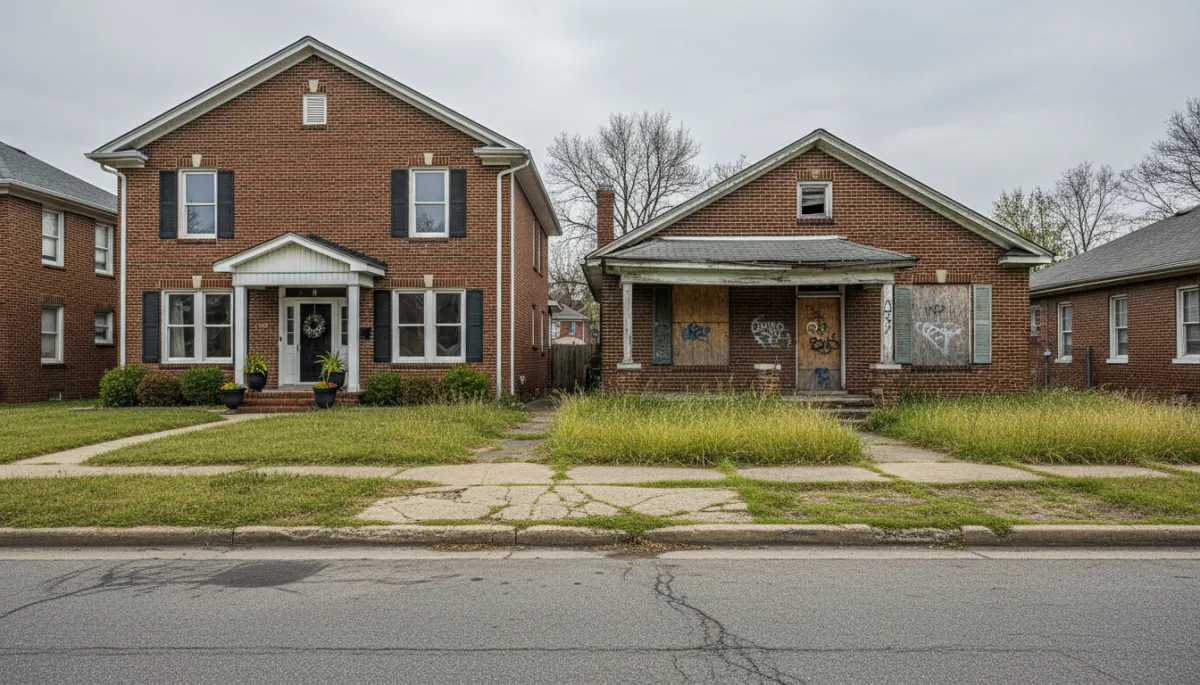
Vacant and neglected homes nearby can drag down even well-kept properties’ resale value.
3. High Property Taxes and Expensive Carrying Costs
Another underappreciated factor hurting property values in Memphis is the cost of simply holding a home. Shelby County’s effective property tax rate hovers around 3.5%, which is high not only for Tennessee but compared with many similar metros nationwide. On a $245,000 home, that translates to roughly $8,575 per year in property taxes alone (Moneylume, 2026).
For buyers, those numbers show up in monthly payment calculators and budget spreadsheets. A home that looks affordable at first glance can quickly feel out of reach when taxes, insurance, and utilities are factored in. When ownership costs feel heavy, demand softens, especially in lower-income neighborhoods. Sellers respond by trimming prices to attract a smaller pool of qualified buyers, and that dynamic can cap appreciation or even push values lower over time.
4. Interest Rates, Affordability Gaps, and Weaker Demand
Mortgage rates in the mid‑6% range may not sound extreme historically, but for buyers who grew used to 3% loans, the shock is real. In 2026, Memphis rates are hovering around 6.8% (Moneylume, 2026). That change alone can add hundreds of dollars to a monthly payment compared with just a few years ago, shrinking the number of households that can comfortably buy at today’s prices.
At the same time, incomes simply haven’t kept pace with housing costs. From 2019 to 2024, median home values in Memphis rose about 106%, while median rents climbed roughly 37% and household incomes increased only around 20% (City of Memphis, 2026). That widening affordability gap limits how much further prices can climb before buyers tap out. Projections already suggest a decline in metro home sales of nearly 7.7% in 2026 (City of Memphis, 2026), which further reduces competition for listings and encourages price cuts in more vulnerable neighborhoods.
5. Neighborhood-Level Economic Weakness and Crime Perception
Memphis benefits from major economic anchors — including the FedEx global hub and large logistics operations by Amazon, UPS, and USPS — that provide a stable base of middle-income jobs. But that strength is unevenly distributed across the city, and some areas still struggle with lower incomes, weaker schools, and higher crime rates (RESMP, 2026).
In neighborhoods where wages lag and job opportunities are limited, buyer pools are smaller and more sensitive to interest rate changes. Investors may still buy for cash flow, but they often do so at discounted prices to compensate for risk. That discount becomes the new comparable sale for the area, pulling down appraisals and expectations for owner-occupants nearby.
Perception matters, too. Even if crime statistics are improving in certain pockets, outdated or exaggerated reputations can linger. Buyers from out of town — and even some local move-up buyers — may avoid entire ZIP codes based on what they have heard, rather than what is actually happening on the ground. That avoidance suppresses demand and, in turn, values.
6. Investor Saturation, High Vacancy, and Rental Risk
Memphis has long attracted investors because of its relatively low prices and strong rent-to-price ratios. Cap rates in the 8–12% range and gross rental yields of 7–10% remain common in many areas (RESMP; PropertyIQ, 2026). That looks great on paper, but heavy investor activity can create its own challenges for property values if it is not balanced by owner-occupants and stable, long-term tenants.
When a large share of homes in a neighborhood are owned by distant landlords, there is a greater risk of inconsistent maintenance and higher turnover. Elevated vacancy — again, close to 19% citywide — means some investors struggle to keep units filled, especially in weaker micro-markets (Moneylume, 2026). To compensate, they may reduce rents or sell at a discount, both of which signal to the broader market that the area is risky. Over time, those patterns can cap appreciation and even nudge values downward, especially for homes that are primarily attractive as rentals rather than as personal residences.
7. Deferred Maintenance and the Wrong Kind of Home Improvements
While market forces and neighborhood trends are powerful, individual property condition still plays a major role in value. In Memphis, cost-conscious buyers and appraisers pay close attention to the basics: roof age, HVAC performance, plumbing and electrical condition, and signs of water damage or foundation issues. Homes that show years of deferred maintenance often sit on the market, inviting low offers and price reductions that hurt not only that property’s value but also nearby comparables.
On the flip side, not every upgrade actually helps. Local experts note that Memphis buyers respond best to practical, mid-range improvements: refreshed kitchens and baths (without over-the-top luxury), updated flooring, solid mechanical systems, better curb appeal, and energy-efficiency upgrades (REI America, 2026). Overspending on highly customized finishes, ultra-high-end appliances, or niche design choices can backfire, because appraisers will not fully credit those expenses and typical buyers may not want to pay extra for them. In neighborhoods where values are already under pressure, over-improvement can lead to a painful gap between what an owner has spent and what the market is willing to pay.
8. Micro-Market Mismatches: Not All of Memphis Moves Together
A final, subtle factor that can hurt perceived property values is the assumption that the entire Memphis market behaves the same way. In reality, the metro is highly segmented. Suburbs like Germantown and Collierville command premiums thanks to strong schools and newer housing stock, while some core-city neighborhoods are still working through decades of disinvestment (RESMP, 2026).
At the same time, pockets of Midtown around Overton Park and Cooper‑Young are benefiting from revitalization and creative-class energy, with Opportunity Zone investments spurring new development nearby. Homes in those micro-markets may appreciate even as citywide averages flatten or decline. For owners in less favored areas, that divergence can feel like a drag on value: buyers comparing options may decide they can get more long-term upside in a different neighborhood for a similar price.
How Memphis Homeowners Can Protect Their Property Value
Many of these forces — interest rates, tax policy, regional vacancy, and investor behavior — are beyond any individual homeowner’s control. But that does not mean you are powerless. In a market like Memphis, where values are increasingly shaped at the neighborhood level, small, consistent actions can make a meaningful difference over time:
Stay current on essential maintenance: roofs, HVAC, plumbing, and exterior paint or siding are non-negotiables for protecting value.
Focus upgrades on broad appeal: clean, modern kitchens and baths, durable flooring, and strong curb appeal tend to deliver the best return locally.
Engage with neighborhood associations and city programs that address blight, code enforcement, and safety — your surroundings are part of your home’s value story.
Price realistically if you sell: in a market with more inventory and cautious buyers, overpricing can lead to long days on market and painful price cuts.
Memphis remains a compelling place to own a home — especially for buyers and investors who do their homework at the neighborhood level. By understanding what is putting downward pressure on values today, you can make smarter decisions about where to buy, how to maintain, and when to sell, even as the market continues to rebalance in 2026 and beyond.