
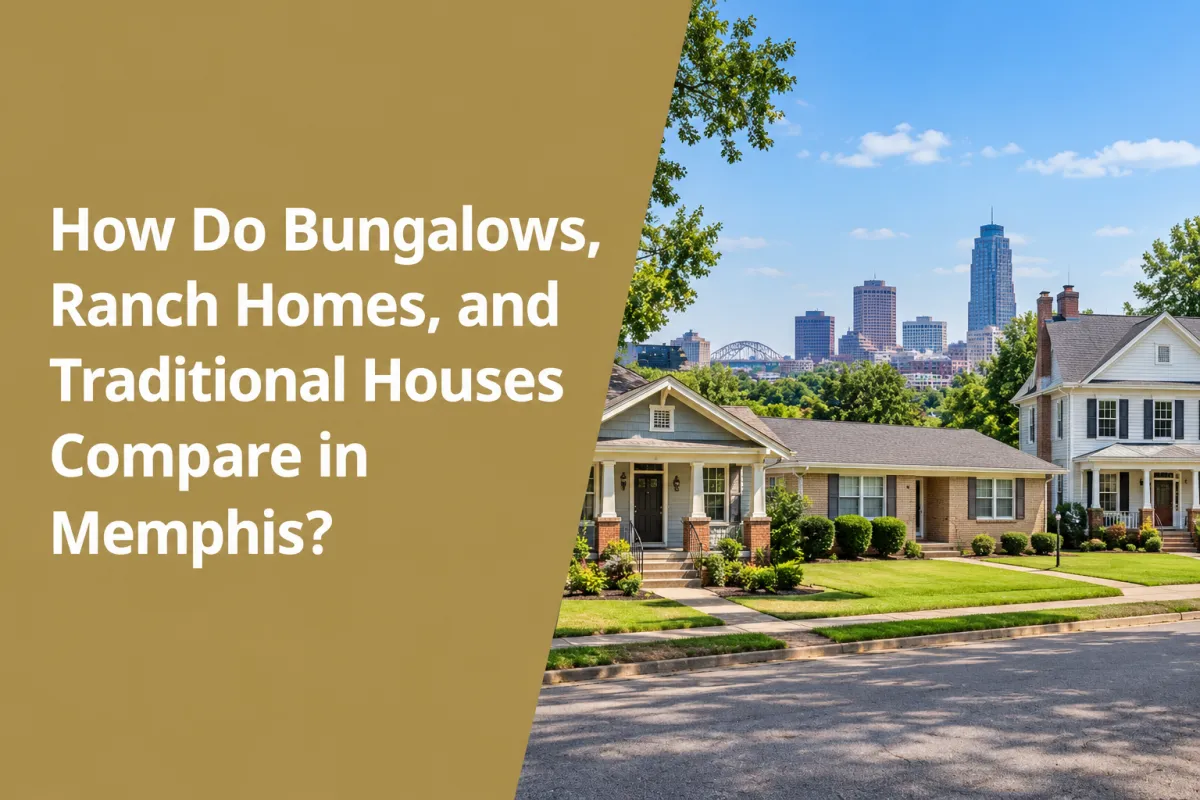
How Do Bungalows, Ranch Homes, and Traditional Houses Compare in Memphis?
When searching for a home in Memphis, buyers may quickly notice that houses can look very different from one street to the next. A charming bungalow may have a covered front porch and a compact footprint, while a Ranch home can stretch across one level with a wider layout. Traditional houses may offer a more defined front entrance, separate rooms, and familiar architectural details.
These differences are more than cosmetic. The style of a house can influence how the space feels, how rooms connect, how outdoor areas are used, and what types of updates may make sense.
For buyers working with a Arlington Realtor, understanding these distinctions can make it easier to compare properties based on how they actually want to live rather than simply focusing on appearance.
Why Memphis Has So Many Different Home Styles
Memphis developed residential neighborhoods across several different periods, and the architecture reflects those changes.
Historic Memphis neighborhoods contain examples of bungalow and Craftsman architecture, while postwar residential development introduced simpler Traditional and Ranch forms. Memphis Heritage identifies Cooper-Young as an area with Bungalow/Craftsman, Colonial Revival, and Queen Anne influences, while Annesdale-Snowden contains numerous bungalow and Craftsman homes.
Other Memphis neighborhoods show the transition toward postwar housing. Plaza Gardens, for example, includes Minimal Traditional homes as well as Ranch houses associated with the changing residential styles of the late 1940s and 1950s.
That history gives today's Memphis buyers something valuable: variety.
Instead of looking at every house as essentially the same, buyers can identify which architectural characteristics fit their priorities.
What Makes a Memphis Bungalow Different?
Bungalows are often recognized by their lower profile, welcoming front porches, and relatively compact floor plans. Many also have architectural details that give the exterior a distinctive personality.
In Memphis, bungalow and Craftsman examples can be found in several historic neighborhoods. Memphis Heritage notes that Cooper-Young has a strong Bungalow/Craftsman presence, while Annesdale Park and Annesdale-Snowden also contain significant bungalow architecture.
For a buyer, the appeal may come from the relationship between the house and the street.
A front porch can create an outdoor sitting area. A smaller footprint may make the home feel more connected from room to room. Older architectural details can also give a property a visual identity that newer construction may not replicate in exactly the same way.
But buyers should look beyond the exterior.
When considering a Memphis bungalow, pay attention to:
The condition of the foundation and structure
Roof age and condition
Electrical and plumbing updates
Insulation and energy-related improvements
Kitchen and bathroom layouts
Storage space
How previous renovations affected the original floor plan
An attractive historic exterior is only one part of the buying decision.
Where Ranch Homes Fit Into the Memphis Housing Story
Ranch homes became increasingly visible as Memphis residential development changed after World War II.
Memphis Heritage's documentation of Red Acres notes the appearance of Ranch and Minimal Traditional homes after World War II. Green Meadows/Poplar Glen also contains Ranch houses and reflects the transition toward more spacious postwar residential designs.
The Ranch layout can feel very different from a traditional bungalow.
Instead of emphasizing vertical space, Ranch homes generally spread living areas across one floor. That can create a straightforward flow between bedrooms, living spaces, kitchens, and outdoor areas.
For some buyers, that arrangement can be especially appealing because everyday activities do not require moving between multiple levels.
When viewing a Ranch home, consider more than square footage. Look at the actual arrangement of the rooms.
Two homes with similar square footage can function very differently depending on whether bedrooms are grouped together, whether the kitchen connects directly to living areas, and whether additions or renovations changed the original layout.
What Does “Traditional” Mean When Comparing Memphis Homes?
Traditional homes can be more difficult to define because the term can describe a range of designs rather than one exact floor plan.
In Germantown, residential architecture includes Colonial-influenced designs, Minimal Traditional homes, and other styles that developed during different periods.
Memphis Heritage's research on High Point Terrace, for example, documents 1920s bungalows alongside postwar Minimal Traditional homes.
Traditional-style homes may appeal to buyers who prefer:
Clearly separated rooms
Defined entrances
Conventional bedroom arrangements
More formal exterior detailing
A recognizable front-facing architectural design
However, every property should be evaluated individually. A home's architectural label does not tell you everything about its current condition, renovation history, or functionality.
A Better Way to Compare the Three Styles
Instead of asking which style is better, Memphis buyers can compare them according to how they plan to use the home.
Feature | Bungalow | Ranch | Traditional |
|---|---|---|---|
Typical feel | Cozy and connected | Open and spread out | Defined and structured |
Common appeal | Character and porch space | One-level living | Traditional room separation |
Exterior character | Often strong architectural details | Usually simpler, wider profile | More defined architectural elements |
Floor-plan consideration | Compact spaces may require creative use | Layout can emphasize horizontal space | Rooms may feel more separated |
Buyer focus | Character, updates, original details | Flow, accessibility, additions | Room arrangement and architectural condition |
This comparison is only a starting point. Memphis contains enough architectural variation that two homes within the same general category can still feel completely different.
What Should You Look at During a Memphis Home Tour?
A home tour should answer practical questions, not just architectural ones.
Walk through the property and notice how you naturally move from one space to another.
Does the kitchen work for the way you cook? Are bedrooms positioned where you want them? Is there enough storage? Does the porch or backyard provide the outdoor space you actually want?
Then look more closely at the property's condition.
Older Memphis homes can have decades of modifications behind them. A home that appears traditional from the street may contain a substantially renovated interior. Likewise, a Ranch home may have additions or remodeling that significantly changed its original layout.
Pay attention to what has changed and whether those changes improve the home's functionality for you.
Does Neighborhood Matter as Much as House Style?
Yes, because architectural style is only one part of a property.
A buyer may love the appearance of a bungalow but discover that the neighborhood, lot, commute, nearby amenities, or street environment does not match their needs.
The same applies to Ranch and Traditional homes.
Memphis offers residential areas with different architectural histories and neighborhood characteristics. That means the search should not stop at “bungalow,” “Ranch,” or “Traditional.”
Instead, consider the combination of:
home style + floor plan + lot + location + condition + lifestyle.
That combination gives a much more useful picture of whether a property belongs on your shortlist.
How a Memphis Realtor Can Help With the Comparison
Working with a Realtor can help buyers turn architectural preferences into practical search criteria.
For example, someone may initially say they want a bungalow in Olive Branch because they like the appearance. After discussing how they use their home, they may discover that the most important feature is actually a single-level floor plan, a particular bedroom arrangement, or a usable outdoor area.
Another buyer may prefer the look of a Traditional home but want an interior that functions more like an open contemporary layout.
A local Realtor can help buyers compare those characteristics while keeping the search focused on properties that fit their actual requirements.
Tony Cai serves buyers and sellers across Memphis and surrounding communities including Cordova, Collierville, Germantown, Lakeland, Arlington, Southaven, and Olive Branch. For someone comparing different types of Memphis homes, local knowledge can be useful when architectural style and neighborhood location need to be considered together.
Which Memphis Home Style Deserves a Closer Look?
There is no single architectural style that works for every Memphis buyer.
A bungalow in Collierville may appeal to someone who values character and porch living. A Ranch may fit someone who prefers a primarily single-level layout. A Traditional home may suit someone who likes defined rooms and classic architectural details.
The better question is not simply which style looks best.
It is:
Which home's layout, condition, location, and character fit the way you want to live?
By comparing those factors together, buyers can make their Memphis home search more focused and avoid choosing a property based only on its exterior appearance.
FAQs About Bungalows, Ranch Homes, and Traditional Houses in Memphis
Are bungalows common in Memphis?
Yes. Memphis has several neighborhoods with documented bungalow and Craftsman architecture, including Cooper-Young, Annesdale Park, and Annesdale-Snowden.
Are Ranch homes found in Memphis?
Yes. Ranch homes became part of Memphis residential development during the postwar period, and documented examples can be found in areas such as Red Acres and Green Meadows/Poplar Glen.
What should I check before buying an older bungalow?
Look beyond the architectural character. Review the home's structural condition, roof, electrical and plumbing systems, insulation, previous renovations, storage, and overall floor plan.
Are Traditional homes always older than Ranch homes?
No. “Traditional” can describe several architectural approaches and does not automatically identify a specific construction period. The individual home's construction date and design should be evaluated separately.
Should I choose a home based on architectural style?
Style can be an important preference, but it should be considered alongside location, floor plan, condition, lot, maintenance needs, and how the property fits your lifestyle.